Note:
This version of the SLA applies to Order Forms executed or renewed on or after November 9, 2026. If your Order Form was executed before this date and has not been renewed or added to since, see Whatfix Service Level Agreement (SLA) Version 1.0.
This Service Level Agreement (SLA) sets forth Whatfix's service level commitments for the SaaS Services. All capitalized terms used and not defined in this SLA have the meanings given to them in the applicable agreement between Customer and Whatfix referencing this SLA (“Agreement”). In the event of conflict between this SLA and the Agreement, the SLA governs service level metrics and associated remedies only.
Key Principle: Whatfix will make available the SaaS Services in accordance with the Uptime Commitments set forth in Platform Availability (Uptime). If Whatfix fails to meet an Uptime Commitment, Customer’s sole and exclusive remedy, and Whatfix’s sole liability, shall be the receipt of Service Credits as provided in the Service Credits section of this SLA. Unavailability caused by factors outside Whatfix's reasonable control (as detailed in SLA Exclusions) shall not constitute a failure to meet this commitment or a breach of the Agreement.
This Service Level Agreement (SLA) supplements the Master SaaS Agreement (SaaS Agreement) or Whatfix Terms of Service (Terms), as applicable, and together such documents and others referenced in the Agreement form a binding agreement (the Agreement) between Whatfix and the Customer. Unless otherwise provided herein, this SLA is subject to the terms and the capitalized terms will have the meaning specified in the SaaS Agreement, as applicable.
The following describes the support services (Support Services) that Whatfix will provide to a Customer, as stated in the Order Form. If nothing is stated in the Order Form, Whatfix will provide Standard support to the extent the Customer has opted and paid for the subscription to the SaaS offering.
Service Level Commitments
Platform Availability (Uptime)
Whatfix will use commercially reasonable efforts to maintain a Quarterly Uptime Percentage of at least 99.9% for the SaaS Services (“Uptime Commitment”), measured using Whatfix’s observability and monitoring infrastructure.
Quarterly Uptime Percentage = [(Total Quarterly Minutes – Downtime Minutes) / Total Quarterly Minutes] × 100
Quarterly Uptime Percentage is calculated per calendar quarter:
Q1: January 1 - March 31
Q2: April 1 - June 30
Q3: July 1 - September 30
Q4: October 1 - December 31
SLA Exclusions
Service Credits do not apply to downtime caused by:
Scheduled Maintenance:
Whatfix will use commercially reasonable efforts to provide at least 7 (seven) days' advance notice for planned maintenance, by email and in-product notification.
Emergency maintenance may occur without notice.
Whatfix uses commercially reasonable efforts to minimize duration.
Third-Party Services:
Upstream cloud hosting provider failures (AWS, Azure, Google Cloud or equivalent) outside Whatfix’s direct control.
Customer SSO provider outages or misconfiguration (Okta, Auth0, and more).
Outages, failures, or misconfigurations of Customer-managed or self-hosted infrastructure impacting the availability of SaaS Services.
Internet and Network:
Internet backbone failures, DNS failures, or propagation delays.
Customer network, firewall, VPN, proxy, or ISP issues or capacity constraints.
Customer Configuration:
Unsupported configurations, browsers, OS versions, or Customer customizations; failure to follow published Documentation, extension deployment guidelines, or integration specifications; or Downtime to the extent caused by Customer’s delay or failure to provide timely technical access or cooperation required for resolution.
Customer failure to apply critical security patches within 30 days.
Customer’s misconfiguration in Whatfix integration.
Security and Force Majeure: DDoS attacks, deliberate security incidents, acts of God, war, pandemic, governmental restrictions, utility failures, labor disputes, failures of telecommunications providers, other force majeure events or necessary emergency security measures taken by Whatfix to mitigate active cyber threats or protect multi-tenant infrastructure integrity.
Service Abuse: The SLA is suspended where Customer abuses the service or exceeds documented limits.
Beta or Unsupported Features:
Alpha, Beta, Preview, Trial, Early Access, Experimental, or unsupported releases.
SLA applies only to Supported Releases as defined in Definitions.
Service Credits
Eligibility
To be eligible for a Service Credit:
The unavailability must materially impact Customer's ability to use the SaaS Services.
Customer must submit a written claim within 30 days following the end of the applicable quarter. Failure to submit a claim within this period constitutes a waiver of the Service Credit.
The unavailability must not fall within the SLA Exclusions.
Customer must not be in material breach of the Agreement, nor more than sixty (60) days past due on any undisputed payment obligations, at the time of the incident or claim.
Structure and issuance
Upon confirming failure to meet the Uptime Commitment, Whatfix issues a Service Credit based on the following schedule:
Quarterly Uptime | Service Credit (% of fees paid for the affected SaaS Services during the applicable quarterly measurement period) | ||
|---|---|---|---|
Standard | Gold | Platinum | |
99.0% to <99.9% | 3% | 4% | 5% |
95.0% to <99.0% | 7% | 8.5% | 10% |
<95.0% | 16% | 18% | 20% |
≥99.9% | None | ||
Note:
Service Credits are subject to the annual cap and other limits in Application and limits.
Application and limits
Service Credits are applied as:
Reduction against Customer's future subscription invoices (not cash refunds).
Non-transferable; cannot be assigned to other accounts.
Annual cap: Total Service Credits issued in a calendar year shall not exceed 20% of annual Subscription Fees paid for the affected SaaS Services in that year.
Unused Service Credits expire twelve (12) months after the end of the calendar quarter in which the applicable Service Credit is granted.
Service Credits are calculated solely with respect to the fees paid for the affected SaaS Services during the applicable quarterly measurement period.
Sole Remedy
Service Credits are the sole and exclusive remedy for Whatfix's failure to meet the Uptime Commitment. Service Credits will not be awarded to compensate for any other forms of loss, including but not limited to lost revenue, operational costs, or any indirect losses experienced by Customer or the end-users. For the avoidance of doubt, nothing in this SLA increases or expands Whatfix's liability beyond the limitations set forth in the Agreement.
Service Credit Claim Process
Written claim: Customer must submit a written request to support@whatfix.com within thirty (30) days following the end of the applicable calendar quarter, including specific dates, times, outage duration, and affected SaaS Services. If Customer fails to submit a complete claim within this thirty (30) day period, Customer’s right to request or receive a Service Credit for that quarter shall be strictly forfeited and waived.
Whatfix review: Whatfix reviews the claim and provides a decision (approve or deny) within 15 business days. Whatfix’s verification is based on Whatfix monitoring data. Upon reasonable request, Whatfix may provide supporting information necessary to validate the calculation.
Credit application: If approved, Whatfix applies credit to Customer's next subscription invoice. If denied, Whatfix provides a written explanation. If Customer disputes the denial, Whatfix and Customer may meet to review the basis for the determination.
Issue Categorization
Whatfix will categorize reported issues in accordance with the priority definitions set forth below. Whatfix will determine the applicable priority based on the nature, severity, and impact of the reported issue. The applicable Initial Response, Ongoing Communication, and Resolution Plan/Workaround targets shall be determined based on the priority assigned to the issue and the Customer’s applicable Support Package, as set forth in Support Scope.
Priority | Definition | Examples |
P1 – Critical | Service down, data loss, critical feature unavailable or go-live blocker. |
|
P2 – Major | Major feature impaired or severe performance degradation. Business continues in restricted mode. |
|
P3 – Minor | Non-critical feature unavailable with workaround available. |
|
P4 – Cosmetic | Routine inquiry, feature question |
|
Customization requests |
|
Support Scope
Service Packages or SKUs
Whatfix Support Team shall provide support, as per support package purchased, on all business days, except for these Support Holidays. Any support queries received on Support Holidays will be collected; however, due action shall be taken on the next business day.
For Standard Support, queries received on Saturdays and Sundays will be collected and actioned on the next business day.
Support Channels: Customer can raise tickets on any of the following designated support channels:
Email ID: support@whatfix.com
Whatfix Support Management System Zendesk
Phone: +1 800-459-7098
The following describes the support services (Support Services) that Whatfix will provide to a Customer, as stated in the Order Form. If nothing is stated in the Order Form, Whatfix will provide Standard support.
Category | Standard | Gold | Platinum |
Support window | Whatfix shall provide Standard 24x5 support | Whatfix Support Team shall provide 24x7 support | Whatfix Support Team shall provide 24x7 support |
Support team Engagement Model | General Support | General Support + Named Support (dedicated SPOC from support team) | General Support + Named Support (dedicated SPOC from support team) |
Ticket Support Interface | Chat + Portal + Email | Chat + Portal + Email | Chat + Portal + Email + Phone |
Support Reviews | Not applicable | Quarterly | Monthly |
CSM (Customer Success Manager) | Yes | Yes | Yes |
P1 |
|
|
|
P2 |
|
|
|
P3 |
|
|
|
P4 |
|
|
|
Whatfix cannot guarantee these timelines if an issue requires complex architectural changes, Customer delays cooperation, an issue is caused by excluded factors, or an incident involves multiple services or cascading failures.
Standard Support does not include
Custom development, consulting, or feature development.
Third-party integrations or API customizations.
Unsupported configurations or environments.
Customer Responsibilities
Customer shall:
Provide timely access to systems and relevant information needed for troubleshooting.
Maintain supported configurations, apply security patches, and use supported environments.
Not reverse-engineer or modify Whatfix’s code or infrastructure.
Cooperate reasonably in resolving incidents.
Designate an authorized technical contact for all SLA communications and incident escalations.
If Customer fails to cooperate or provide necessary access, SLA timelines may be extended. Whatfix is not responsible for breaches caused by Customer's failure to cooperate.
Status Page
Whatfix maintains a public status page at status.whatfix.com that displays current service status, incident history, and end-user uptime.
The status page is updated periodically during incidents.
Whatfix's public status page (status.whatfix.com) serves as the primary channel for service incident communication. SLA calculations are based on Whatfix's internal monitoring and observability data, specifically the end-user uptime, as the system of record. Upon reasonable request, Whatfix will provide the relevant monitoring data to support a Customer's Service Credit claim or dispute.
Security Incidents
Security incidents are managed under the Whatfix Security Incident Response Policy, not this SLA. In the event of any inconsistency, the Security Incident Response Policy or the Agreement shall prevail.
Definitions
Downtime: A period during which the SaaS Services suffer a Material Impact directly resulting from a failure of Whatfix-managed infrastructure. Downtime does not include non-material disruptions, performance degradation, non-core feature unavailability, or any events detailed under SLA Exclusions.
Material Impact: An operational state where the SaaS Services fail to respond to valid requests for core platform functionality (such as serving digital adoption flows, widgets, or overlays), completely or substantially preventing Customer from using the SaaS Services for its intended business purpose, as distinguished from cosmetic issues, analytics delay, or secondary feature disruptions.
Resolution Plan/Workaround: Feasible change in operating procedures whereby an end-user can avoid a possible impact without any material inconvenience.
Service Credit: Percentage reduction applied to future invoices (not cash refund, non-transferable).
Supported Release: A version of the SaaS Services made generally available within the current or immediately preceding calendar quarter.
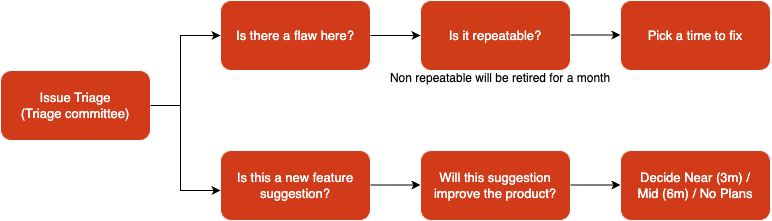
Internal Support Process Flow:
Note:
Whatfix disclaims all warranties except as expressly provided in this SLA. Whatfix does not warrant uninterrupted, error-free, or secure operation.
Modifications and Rights
SLA changes: This version of the SLA applies to all Order Forms executed or renewed on or after November 9, 2026. If Customer executes an Order Form for any new, additional, or upgraded services on or after this date, this SLA shall automatically supersede any prior service level agreements and will govern all services on Customer's account.
For customers with an active Order Form executed prior to November 9, 2026 (who have not executed a subsequent renewal or add-on Order Form), the previous version of the SLA, available at Whatfix Service Level Agreement (SLA), shall remain in full effect until the next subscription renewal.
Whatfix may modify this SLA with 30 days' written notice.
Reservation of rights: Nothing in this SLA obligates Whatfix to modify its product roadmap, engineering priorities, release schedule, or feature development, including the timing of any updates or releases.
Suspension of the SLA: The SLA shall not apply during any period in which Whatfix suspends the Services in accordance with the Agreement, including for non-payment, security concerns, illegal use, or material breach by Customer.
No waiver: Failure by Whatfix to enforce any provision of this SLA on one occasion does not constitute a waiver of its right to enforce that provision in the future.
Entire agreement: This SLA forms part of the Agreement and does not create any obligations independent of the Agreement.